
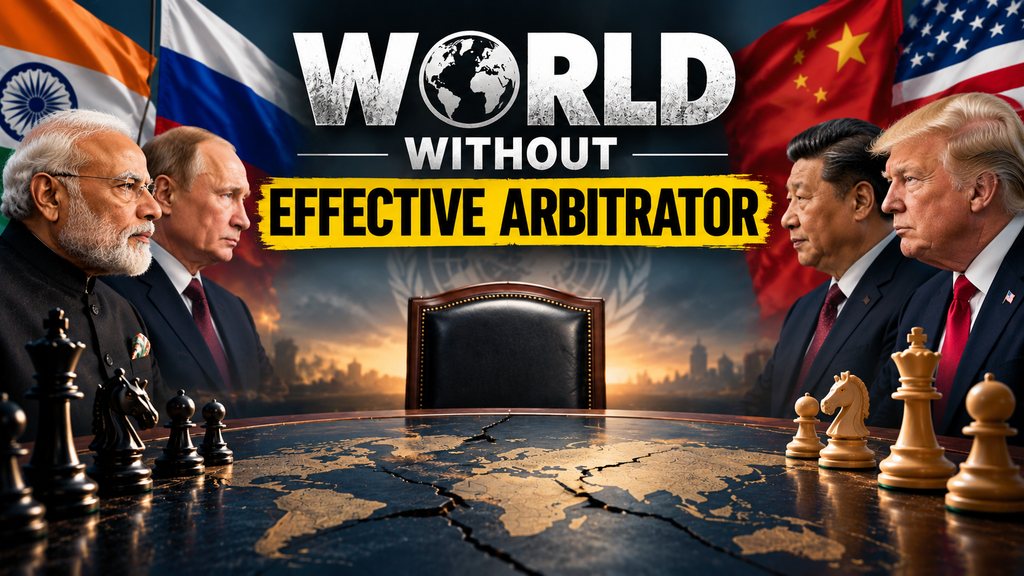
World Without Effective Arbitrator
Abstract
The international system in the twenty-first century is characterised by growing complexity, uncertainty, and rapidly shifting alignments driven by national interests, domestic political compulsions, and socioeconomic pressures. Traditional distinctions A World of Shifting Alliances and Unsettled Power. The geopolitical landscape of the twenty-first century is characterised by uncertainty, persistent rivalry and shifting relationships. The traditional distinctions between friends, allies, partners and competitors have become increasingly fluid as states recalibrate their relationships in response to changing strategic realities. National interests, rather than ideological affinity or historical partnerships alone, increasingly determine the choices nations make.
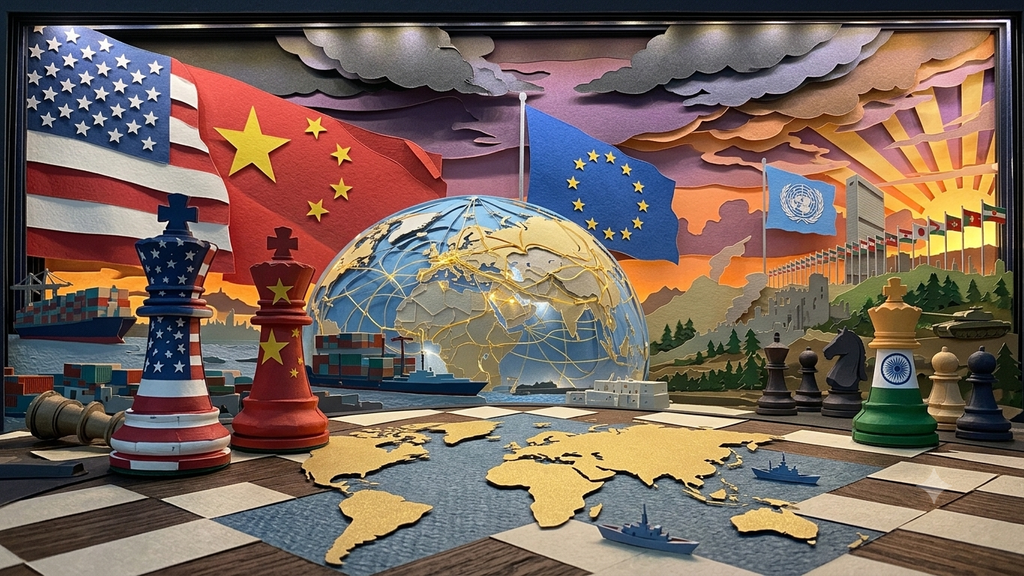
At the centre of this transformation lies the strategic rivalry between the United States, the pre-eminent global power of the post-Cold War era, and China, a civilisational state seeking to restore what it considers its historical centrality in the international order (Singh, Kondapalli, & Mahapatra, 2023). Through economic integration, industrial expansion, technological advancement and military modernisation, China has significantly altered the global balance of power. The strategic opening between Washington and Beijing in the early 1970s, facilitated by Pakistan, transformed international relations (Khalid, 2021). Whether its long-term consequences were fully anticipated remains a subject of strategic debate.
At the centre of this transformation lies the strategic rivalry between the United States, the pre-eminent global power of the post-Cold War era, and China, a civilisational state seeking to restore what it considers its historical centrality in the international order (Singh, Kondapalli, & Mahapatra, 2023). Through economic integration, industrial expansion, technological advancement and military modernisation, China has significantly altered the global balance of power. The strategic opening between Washington and Beijing in the early 1970s, facilitated by Pakistan, transformed international relations (Khalid, 2021). Whether its long-term consequences were fully anticipated remains a subject of strategic debate.
Europe faces a different but equally consequential set of challenges. Demographic shifts, economic stagnation in several economies, energy insecurity, political polarisation and the social pressures associated with migration have tested the resilience of European societies (Bosch & Walravens, 2025; Svazas et al., 2025). The continuing war in Ukraine has further strained resources, reshaped defence priorities and exposed vulnerabilities in the continent’s security architecture. Europe must now balance internal cohesion with the demands of a more contested external environment.
Elsewhere, instability remains widespread. West Asia continues to experience recurring conflicts and geopolitical confrontation. Eurasia remains a theatre of competing strategic interests, while the Indo-Pacific has emerged as a principal arena of major-power rivalry. The Indian subcontinent continues to confront enduring security challenges. Africa, despite receiving comparatively limited international attention, faces a convergence of insurgencies, fragile governance, military coups, humanitarian crises and competition for critical resources.
These developments are unfolding at a time when governments are increasingly preoccupied with domestic political pressures, economic resilience and rising public expectations. Consequently, major powers are more inclined to employ sanctions, export controls, technology restrictions, economic leverage and selective military intervention to advance their interests (Falkner, 2026). Their willingness to act as impartial stabilisers of the international system has become increasingly uncertain.
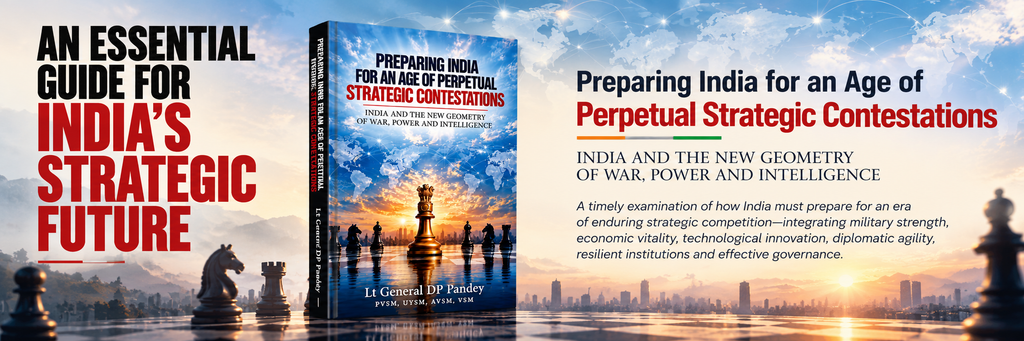
The institutions established after the Second World War are also struggling to respond effectively. Strategic rivalry among major powers has constrained collective decision-making, while competing national interests have weakened multilateral efforts to prevent and resolve conflicts (Milanovic, 2022). The gap between the need for collective action and the willingness of states to undertake it continues to widen.
For nations navigating this environment, strategic autonomy, resilient institutions and diversified partnerships are becoming increasingly important. India, in particular, must preserve its freedom of decision while strengthening its economic, technological, diplomatic and military capabilities.
“The defining challenge of this century is not merely to identify friends and adversaries, but to understand how interests change, how power is exercised and how national strength can be preserved amid uncertainty. In a world of shifting alignments, enduring national interests must remain the compass of statecraft.”
Author
Lt Gen Devendra Pratap Pandey (Retd)
Former Corps Commander, Chinar Corps | DG Territorial Army | Director of Military Intelligence | Commandant, Army War College
Read the original paper


You May Also Like to Watch
Copyright & Disclaimer
© All Rights Reserved 2026, Centre for Land Warfare Studies (CLAWS).
The original Issue Brief this piece references was published in September 2026. Views expressed are the author’s own, in his personal capacity. This content is shared on this website for educational and informational purposes, with full credit to CLAWS as the original publisher.
Keywords
World without arbitrator, shifting alliances, US-China rivalry, multipolar order, strategic autonomy, post-war institutions, multilateral decline, sanctions and export controls, Europe security challenges, West Asia instability, Indo-Pacific rivalry, Africa instability, national interest, comprehensive national power, 21st century geopolitics, India foreign policy.
In my view, Lt Gen D. P. Pandey represents the kind of military leader India needs more of: operationally hardened, intellectually engaged, and willing to look beyond conventional security responses. He combines the credibility of someone who has served in Siachen, Ladakh, and Kashmir with the communication skills needed to explain complex security issues to a wider public.
His greatest contribution lies not only in the positions he held, but in the way he approached them—treating leadership as both a military responsibility and a human one. Whether commanding troops in extreme terrain, managing counter-insurgency in Kashmir, or mentoring future leaders, he has consistently emphasised initiative, trust, and the connection between security and society.
In short: Lt Gen D. P. Pandey is a distinguished soldier, thoughtful strategist, and influential public voice on national security—someone whose career offers valuable lessons in courage, adaptability, and leadership under pressure.
In my view, Lt Gen D. P. Pandey represents the kind of military leader India needs more of: operationally hardened, intellectually engaged, and willing to look beyond conventional security responses. He combines the credibility of someone who has served in Siachen, Ladakh, and Kashmir with the communication skills needed to explain complex security issues to a wider public.
His greatest contribution lies not only in the positions he held, but in the way he approached them—treating leadership as both a military responsibility and a human one. Whether commanding troops in extreme terrain, managing counter-insurgency in Kashmir, or mentoring future leaders, he has consistently emphasised initiative, trust, and the connection between security and society.