
Theatre Commands: Powering Bharat’s Strategic Leap into the Future
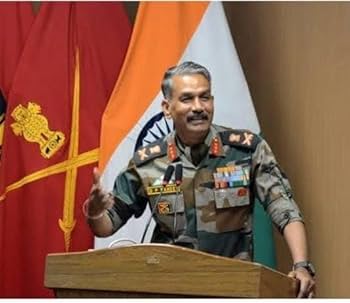
LT GEN DP PANDEY (R)
Former Corps Commander, Chinar Corps | DG Territorial Army | Director of Military Intelligence | Commandant, Army War College
In this Issue Brief, Lt Gen Devendra Pratap Pandey (Retd.) himself the author weighs in on India’s long-delayed theaterisation debate, six years after the creation of the CDS and Department of Military Affairs. He references the recent public divergence of views among India’s top military leadership at “Ran Samwad” in Mhow, where the Air Chief cautioned against rushing the rollout while the Naval and Army Chiefs reaffirmed their commitment to theatre commands.
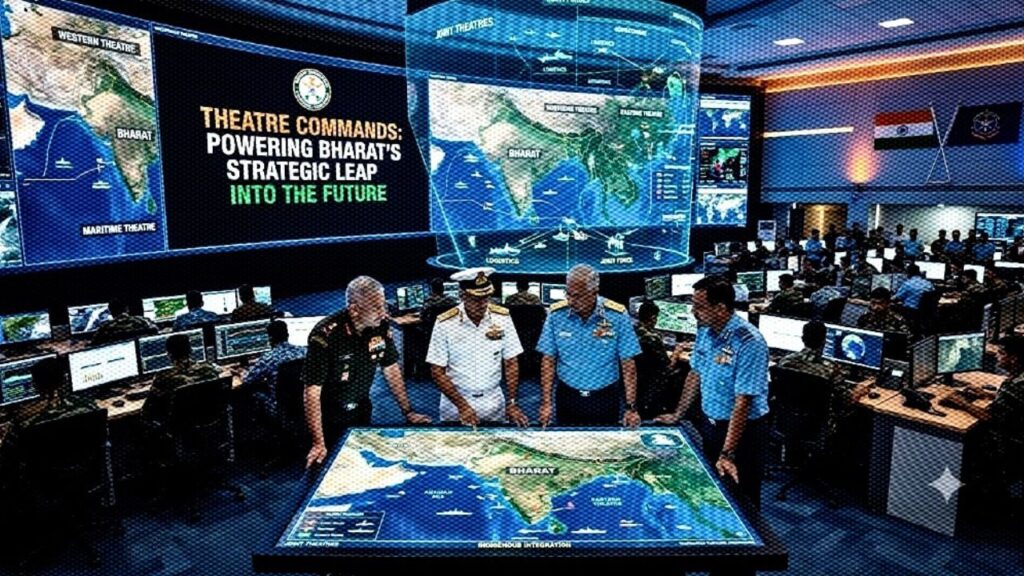
His own position is a pointed one: theaterisation is necessary, but not in the narrow, subcontinent-bound form currently being discussed. He argues that adding a theatre command headquarters as just another bureaucratic layer would slow down decision-making at a time when transparent battlefields and hypersonic-class weapons demand speed, not hierarchy.
The brief calls for a theatre command structure that is outward-looking and civilizational in ambition one that positions the Indian military not just as a war fighting force, but as an instrument of diplomacy, disaster relief, and global stability, echoing India’s historical maritime reach under the Cholas. He proposes a concrete roadmap: five theatre commands three land-centric (Western, Northern, Eastern), one maritime, and one Strategic Air Command each empowered for multi-domain operations and built to last the next 30-40 years, not merely to satisfy a bureaucratic exercise. He closes by framing this as India’s civilisational responsibility as it moves toward Viksit Bharat 2047.

Copyright & Disclaimer
© All Rights Reserved 2025, Centre for Land Warfare Studies (CLAWS).
No part of this publication may be reproduced, copied, archived, retained, or transmitted through print, speech, or electronic media without prior written approval from CLAWS. The views expressed and suggestions made in the article are solely those of the author in his personal capacity and do not carry any official endorsement. Responsibility for the contents rests entirely with the author.