
India’s Op Sindoor Shows Why Clear War Aims Matter in Modern Conflicts
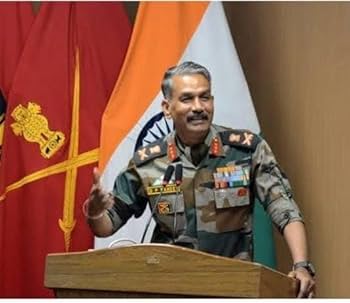
Lt Gen Devendra Pratap Pandey (Retd)
Former Corps Commander, Chinar Corps | DG Territorial Army | Director of Military Intelligence | Commandant, Army War College
What the Article Says
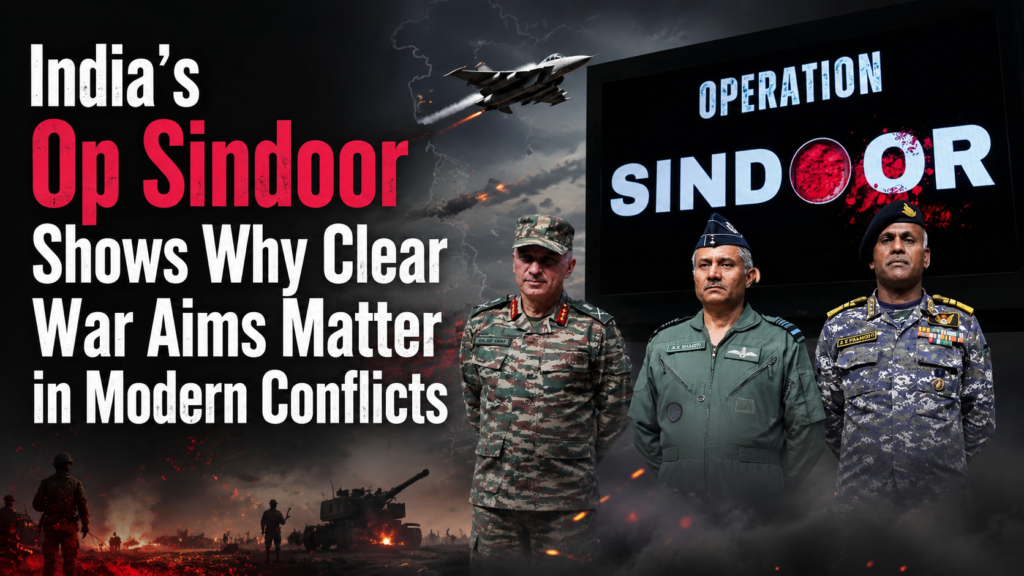
In this piece for The Economic Times, Lt Gen D.P. Pandey (Retd.) contrasts India’s Operation Sindoor with the drawn-out, goalpost-shifting conflicts seen in Afghanistan, Iraq, Ukraine, Gaza, and now Iran. His central argument: modern warfighting fails when political and military objectives keep shifting mid-campaign, turning decisive action into open-ended, ambiguous engagement that ultimately costs the initiator its advantage.
Op Sindoor, he writes, followed a brutal, religiously-targeted provocation by Pakistan’s security establishment yet India’s response was neither emotional nor unbounded. It followed a structured escalation ladder, with each rung calibrated to hit specific targets while signalling both capability and restraint. The politico-military objective was clear from the outset: impose immediate, tangible costs on cross-border terror infrastructure and restore deterrence within the framework of the nuclear umbrella and international law. Once that objective was achieved within 88 hours India halted, and Pakistan’s military establishment, which had assumed it could provoke without consequence, sought a ceasefire.

Snow Leopards of Gurez: The Prisoner and the Spy Who Exposed Pakistan’s Kargil Plot
Months before the world knew “Kargil,” a captured Pakistani soldier’s confession in Gurez Valley exposed the truth behind the war and vindicated the brigade that dared to hold the peaks.
Lt Gen Pandey argues that Pakistan’s “bleeding India through a thousand cuts” doctrine cannot survive a short, sharp response aimed at its core levers of power, because its institutional dependence on hostility with India is existential rather than merely strategic. India, he notes, didn’t attempt to “solve” Pakistan only to impose cost and restore deterrence without falling into an endless escalation trap.
He draws a sharp comparison to the US campaign in Iran, where early objectives were met within weeks, but the mission drifted toward open-ended presence and shifting goals repeating the pattern of Iraq and Afghanistan, and ultimately draining American credibility and inviting asymmetric blowback. The piece closes by framing India’s swift pivot back to its development priorities under PM Modi’s leadership as proof that escalation control not just force defines success in modern conflict.
You May Also Like to Watch
In this episode, former Chinar Corps Commander Lt Gen D.P. Pandey draws on his years of frontline command experience to unpack the inner workings of terrorism in Kashmir, including Pakistan’s hand in keeping the terror network alive. He also walks through how the Indian Army identifies and dismantles these threats on the ground in one of the world’s most closely watched conflict zones.

Copyright & Disclaimer
This article, “India’s Op Sindoor Shows Why Clear War Aims Matter in Modern Conflicts,” is authored by Lt Gen Devendra Pratap Pandey, PVSM, UYSM, AVSM, VSM (Retd.), and was originally published by The Economic Times (ET Contributors). All rights to the original article rest with The Economic Times / Bennett, Coleman & Co. Ltd. This blog post presents only a brief summary for informational purposes and does not reproduce the article in full. Views expressed are the author’s own. For the complete article, readers are directed to the original publication on The Economic Times website.