
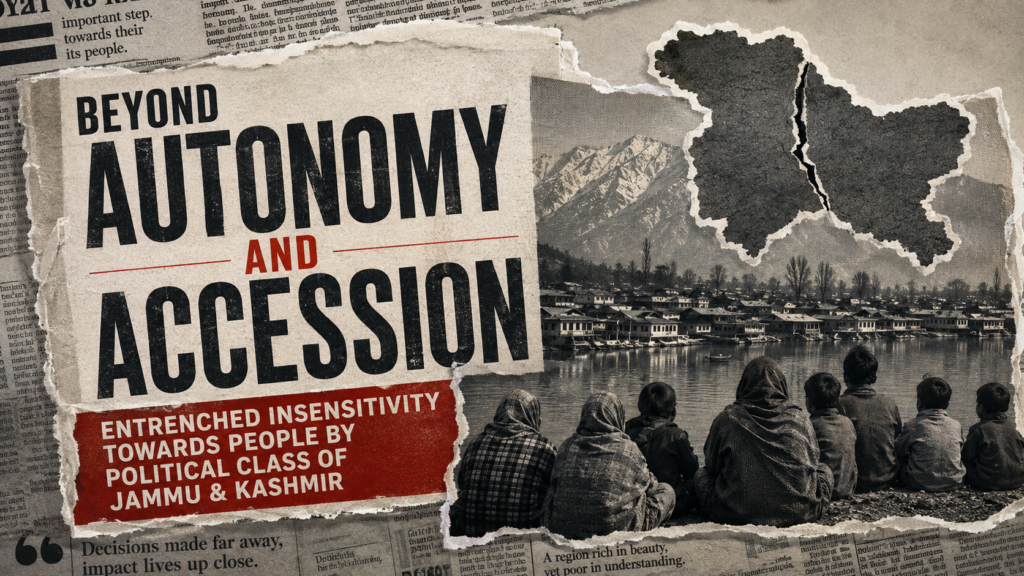
Beyond Autonomy and Accession: Entrenched Insensitivity towards People by Political Class of Jammu and Kashmir
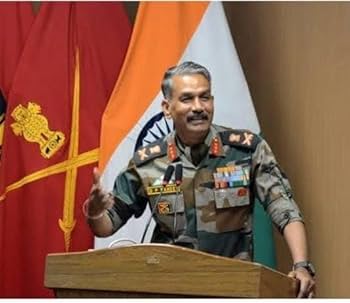
Lt Gen Devendra Pratap Pandey (Retd)
Former Corps Commander, Chinar Corps | DG Territorial Army | Director of Military Intelligence | Commandant, Army War College
Overview
In this Issue Brief, Lt Gen Devendra Pratap Pandey (Retd.) traces nearly eight decades of political conduct in Jammu and Kashmir, arguing that leaders across ideological lines not just one party or era have consistently prioritised identity mobilisation, religious symbolism, and constitutional brinkmanship over governance and development, leaving the region’s population to bear the cost.
He builds the argument around three recurring tendencies: ambivalence, brinkmanship, and callousness. He traces this pattern back to the very moment of accession, when Maharaja Hari Singh’s hesitation between India, Pakistan, and independence delayed the Instrument of Accession and ultimately cost the region territory and decades of instability. He then examines Sheikh Abdullah’s balancing act between religious and socialist appeal, the incorporation of Article 370 as a political lever, and the oscillating cycle of dismissal, arrest, and reconciliation that followed. The piece walks through the rise of the National Conference and PDP, arguing both parties despite differing idioms mastered the same strategy of pushing constitutional boundaries for political relevance without ever fully breaking from Delhi.

Get Your Copy of Snow Leopards of Gurez: The Prisoner and the Spy Who Exposed Pakistan’s Kargil Plot
The brief argues that even the 2019 abrogation of Article 370 and the restoration of electoral politics in 2024 have not broken this pattern pointing to early Assembly sessions that revived symbolic contests over already-adjudicated issues instead of focusing on jobs, education, and fiscal reform. He also highlights how Valley-centric politics has historically sidelined the concerns of Jammu, Ladakh, and border communities, and links the region’s persistent instability to what scholars call a “conflict economy,” where political capital is generated by grievance rather than resolved by peace. He closes by calling for a shift from symbolism to substance arguing that only accountability, consistent constitutional messaging, and equal regional representation can break the cycle.
You May Also Like to Watch
Copyright/Disclaimer:
© All Rights Reserved 2026, Centre for Land Warfare Studies (CLAWS).
No part of this publication may be reproduced, copied, archived, retained, or transmitted through print, speech, or electronic media without prior written approval from CLAWS. The views expressed and suggestions made in the article are solely those of the author in his personal capacity and do not carry any official endorsement. Responsibility for the contents lies purely with the author. This summary is shared on this website purely for educational and informational purposes, with full credit to CLAWS as the original publisher.