
21st Century World: Embroiled in Endless Conflict
By Lt Gen DP Pandey, PVSM, UYSM, AVSM, VSM (Retd), author of the forthcoming book “Preparing India for an Age of Perpetual Strategic Contestations.”
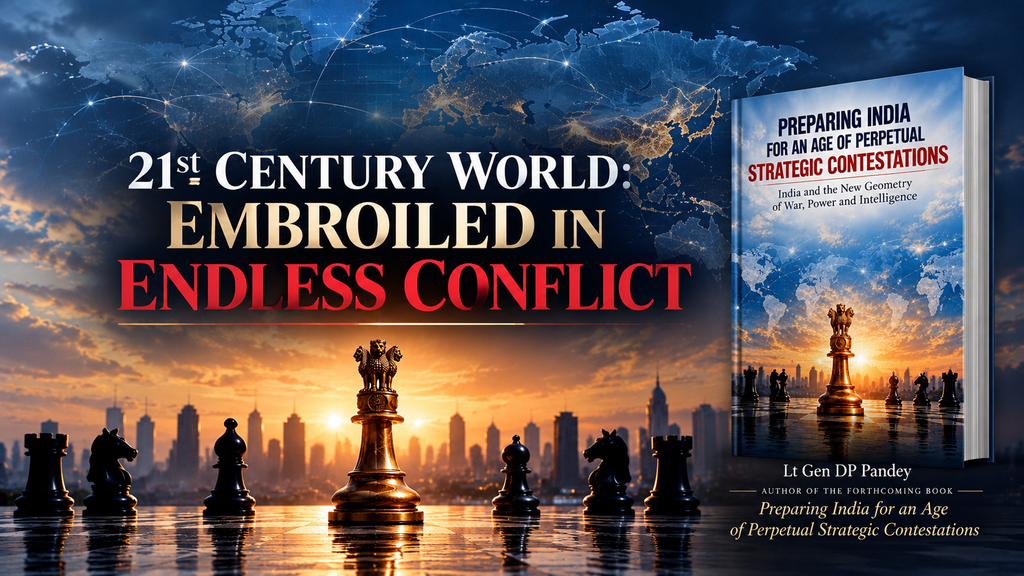
The twenty-first century was meant to be peaceful. Globalisation, economic interdependence and technological connectivity were expected to make war too costly. Instead, strategic competition has spread across military, economic, technological, informational, cyber and societal domains, and the same connected systems that created prosperity have become instruments of coercion. This post summarises my CLAWS Issue Brief on the subject. Its argument is simple: military success alone no longer constitutes strategic success, and the enduring objective of strategy must be to preserve and enhance comprehensive national power over the long term.
Five propositions
- The twenty-first century is defined by persistent strategic competition, not episodic conflict.
- Technology has extended that competition into every domain of national power.
- Military success no longer guarantees strategic success.
- Competition now centres on technological, economic and informational advantage, not territory alone.
- The foremost objective of strategy is to preserve and enhance comprehensive national power.
An illusion that did not last
The last quarter of the twentieth century was comparatively stable. The internet, aviation and global shipping knitted the world into one economic system, and Keohane and Nye’s idea of complex interdependence suggested that trade would make cooperation necessary. Several countries even reduced their armed forces. Then 9/11 showed that the very networks connecting the world could be exploited by transnational terrorists, and the confidence of that era gave way to a more contested order.

A world without an effective arbitrator
The defining rivalry of the century is between the United States and a rising China. Europe, strained by demographics, energy insecurity, migration and the war in Ukraine, is preoccupied with internal cohesion. West Asia, Eurasia, the Indo-Pacific and Africa are each unsettled in their own way. Few states can act as impartial stabilisers, post-war institutions have lost effectiveness, and great powers increasingly rely on sanctions, export controls and economic leverage rather than consensus.
Technology lowers the barrier to entry
Inexpensive drones and missiles allow weaker actors to impose heavy costs on stronger ones, as the Houthis have done to Red Sea shipping. Cyber operations target power grids, finance and transport below the threshold of war, and India reported a sharp rise in attacks on critical infrastructure during Operation Sindoor in May 2025. Information operations shape opinion across borders. Technology has not replaced conventional warfare; it has made competition continuous.
Local crises, global consequences
A confrontation in one region now travels quickly through energy markets, supply chains and migration routes. The tensions around the Strait of Hormuz, and displacement from Africa and Myanmar, show how local instability becomes a global burden.
Easy to enter, difficult to exit
The United States and Iran, Israel and Hamas, Russia and Ukraine, and the earlier wars in Afghanistan and Iraq point to the same lesson: winning battles is easier than securing a favourable and lasting peace. Modern conflicts spread across economic, cyber, legal and diplomatic domains, which makes disengagement as hard as intervention.
The contest for resources, technology and markets
Semiconductors, artificial intelligence, rare earth minerals, energy networks and undersea cables have become strategic assets. Interdependence, once seen as a guarantor of peace, is now used as leverage. The Trump presidency accelerated this shift rather than originating it, since the US-China rivalry and the push for supply-chain security were already under way.
What it means for India
India sits at the intersection of major geopolitical fault lines. It must preserve strategic autonomy while investing in cyber, space, artificial intelligence, advanced manufacturing, semiconductors, energy security, maritime power and critical minerals. Social cohesion and institutional resilience are equally part of national power. The aim is not only to respond to crises but to shape an environment that protects India’s long-term interests.
In this new strategic environment, the ultimate measure of success will not be the number of battles won or crises managed, but the ability of the state to emerge stronger, more resilient, and more influential after every phase of competition.
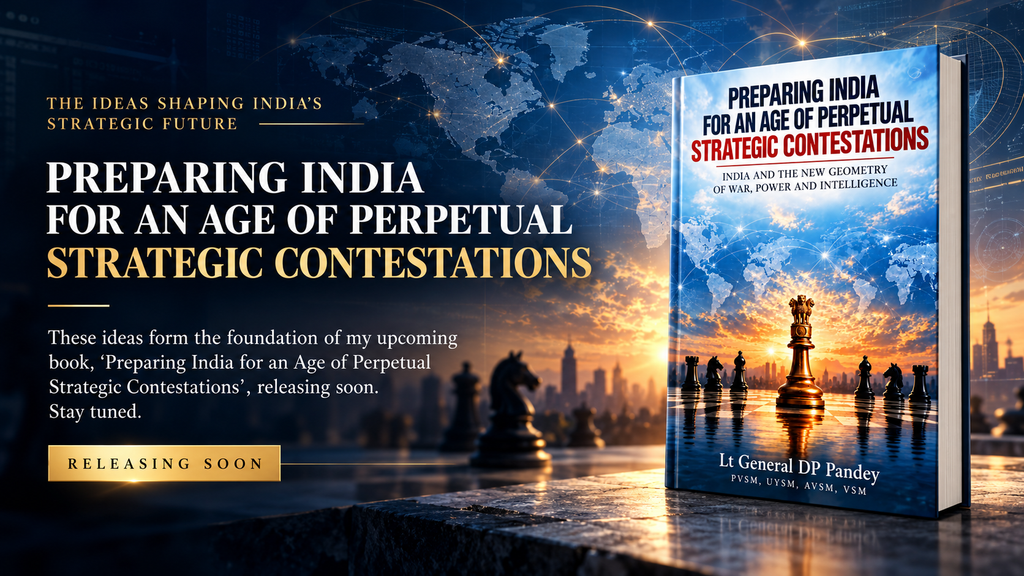
This is the question I explore at length in my forthcoming book, Preparing India for an Age of Perpetual Strategic Contestations: India and the New Geometry of War, Power and Intelligence. Its argument is simple: in an age where competition never really ends, India’s task is to prepare for it without exhausting itself. The era of expecting permanent peace has passed. The twenty-first century belongs to nations that can compete continuously without exhausting their national strength.
Read the full analysis in CLAWS Issue Brief No. 549, ‘21st Century World Embroiled in Endless Conflict:
About the Author
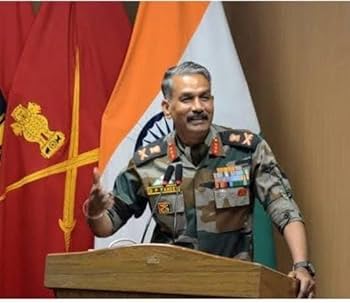
Lt Gen Devendra Pratap Pandey (Retd)
Former Corps Commander, Chinar Corps | DG Territorial Army | Director of Military Intelligence | Commandant, Army War College
You May Also Like to Watch
Copyright and Disclaimer
Copyright: © 2026 Lt Gen DP Pandey. All rights reserved. This post is adapted from CLAWS Issue Brief No. 549, “21st Century World Embroiled in Endless Conflict” (September 2026), © 2026 Centre for Land Warfare Studies (CLAWS). No part of this post may be reproduced, copied, archived, retained or transmitted through print, speech or electronic media without prior written permission.
Disclaimer: The views expressed in this post are solely those of the author in his personal capacity and do not carry any official endorsement. Attributability of the contents lies purely with the author.
Keywords: Strategic Competition, Endless Conflict, Geopolitical Rivalry, Economic Interdependence, Technological Connectivity, Comprehensive National Power, National Security, Grey-Zone Warfare, India Strategy, Strategic Autonomy