
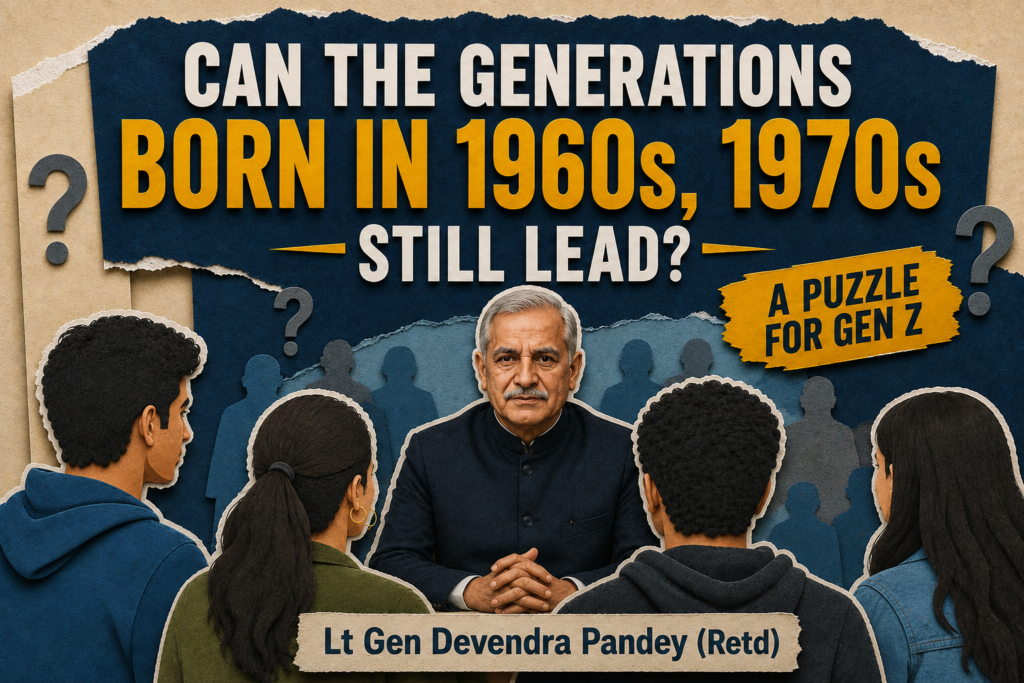
Can the Generations Born in 1960s-1970s Lead?
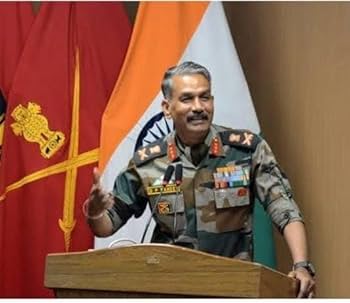
Lt Gen Devendra Pratap Pandey (Retd)
Former Corps Commander, Chinar Corps | DG Territorial Army | Director of Military Intelligence | Commandant, Army War College
In Brief
Many of today’s leaders, analysts and institutions were educated, trained and professionally shaped during the relatively stable decades following the Cold War. It was a period characterised by predictable power structures, dominant international institutions, expanding globalisation and relatively clear strategic assumptions. Strategy in that era could be built on the assumption that today’s alliances, doctrines, and threat assessments would largely hold true a decade later. Yet the world that has emerged in the twenty-first century is fundamentally different.
The certainties of the past are steadily eroding. Technology is advancing at unprecedented speed. Artificial intelligence, autonomous systems, cyber capabilities, space technologies and data-driven decision-making are reshaping the nature of power. Power today is no longer measured only in territory, population, or the size of standing armies it increasingly rests on who controls data, algorithms, and the invisible infrastructure that connects nations, markets, and militaries alike. Information now travels faster than governments can react. Political developments in one region can create immediate strategic consequences thousands of miles away. Economic interdependence, once viewed primarily as a source of prosperity, is increasingly being weaponised through sanctions, supply chains and technological restrictions.
Get Your Copy of Snow Leopards of Gurez: The Prisoner and the Spy Who Exposed Pakistan’s Kargil Plot
The nature of conflict itself has changed alongside this shift. Boundaries between war and peace, combatant and civilian, state and non-state actor have blurred, with hybrid threats combining cyber intrusion, economic pressure, and information manipulation unfolding continuously rather than through clearly declared confrontations. Decision-making windows that once spanned weeks or months have compressed to hours, leaving little time for the kind of deliberate, institution-driven strategic thinking that defined the Cold War generation’s formative years.
Even the most experienced strategic establishments are struggling to adapt. The United States, Europe, China, Japan and other major powers are all grappling with the same challenge: how to formulate coherent long-term strategies in a world where tactical events, political pressures and technological disruptions can alter the strategic landscape overnight. Institutions built to manage a slower, more linear world now find themselves reacting in real time to disruptions they were never designed to anticipate, exposing a widening gap between experience and readiness.
Are the current leaders prepared for the rapidly transitioning geo political and strategic environment?
You May Also Like to Watch
Copyright
© Lt Gen D.P. Pandey (Retd.). All rights reserved. This article reflects the personal views of the author and does not represent the official position of any organisation he is affiliated with. No part of this content may be reproduced or republished without prior permission.
Keywords
generational leadership, strategic thinking, geopolitics, Cold War generation, artificial intelligence, hybrid warfare, cyber capabilities, information warfare, national security strategy, technological disruption, global power shift, decision-making, military leadership, 21st century warfare, strategic readiness