
Why the 21st Century Never Found Its Peace
Written by : Lt Gen DP Pandey (Retd)
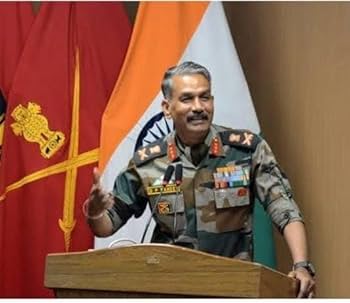
Lt Gen Devendra Pratap Pandey (Retd)
Former Corps Commander, Chinar Corps | DG Territorial Army | Director of Military Intelligence | Commandant, Army War College
In Brief
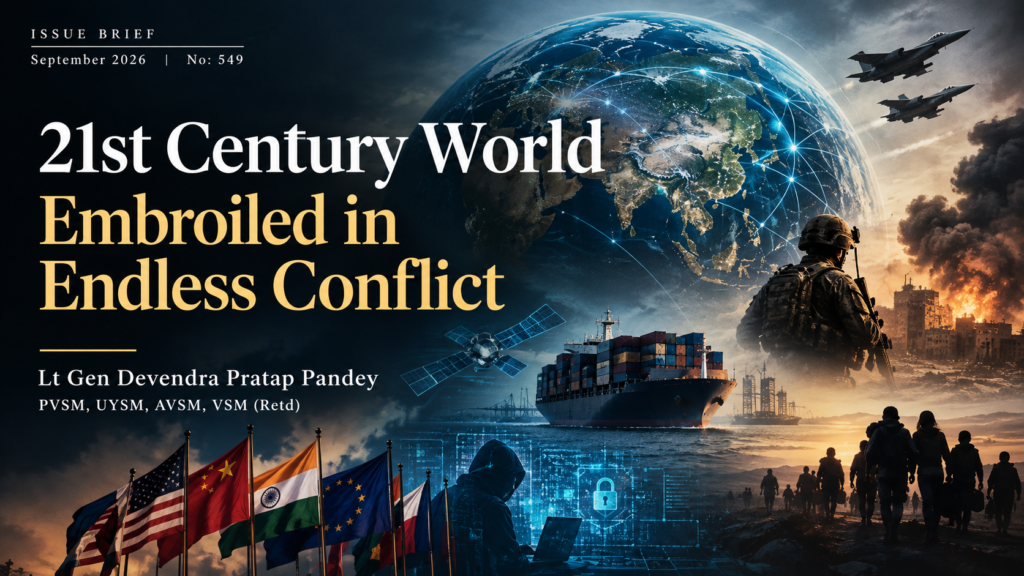
The post-Cold War world was supposed to be the peaceful one globalisation, economic interdependence, and technological connectivity were expected to make major conflict too costly to pursue. In this Issue Brief for CLAWS, Lt Gen D.P. Pandey (Retd.) argues that this expectation has been decisively overturned. Instead of ushering in stability, the twenty-first century has seen strategic competition expand into every domain military, economic, technological, informational, cyber, and societal with the very systems that connected the world becoming new instruments of coercion.
The brief traces this shift from the 9/11 attacks, which demonstrated how interconnected technologies could be exploited by non-state actors, through to today’s environment where relatively weak actors the Houthis, Hamas, Hezbollah can impose disproportionate costs on vastly more powerful states using inexpensive drones and missiles. It examines the defining US-China rivalry, a fractured and inward-looking Europe, persistent instability across West Asia, Eurasia, the Indo-Pacific, and Africa, and the declining effectiveness of postwar international institutions that once managed global crises.
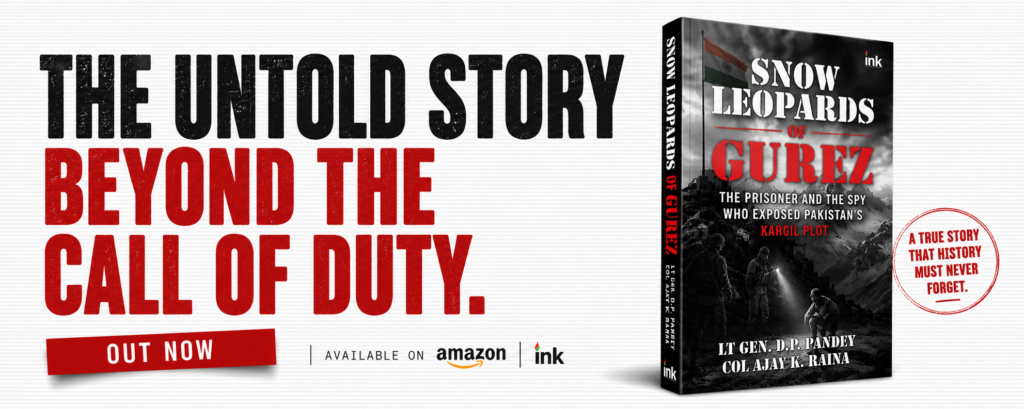
Get Your Copy of Snow Leopards of Gurez: The Prisoner and the Spy Who Exposed Pakistan’s Kargil Plot
Central to the paper is the argument that military success alone no longer equals strategic success. Technology has lowered the barriers to entry for conflict, resource and rare-earth competition has become a proxy battlefield, and migration, climate displacement, and transnational extremism have added new, harder-to-manage sources of instability. The brief concludes that in an era without an effective global arbitrator, the true objective of statecraft is not any single victory, but the sustained preservation and enhancement of comprehensive national power over the long term.
Read Full Document 👇🏻
You May Also Like to Watch
Copyright & Disclaimer
© All Rights Reserved 2026, Centre for Land Warfare Studies (CLAWS).
No part of this publication may be reproduced, copied, archived, retained, or transmitted through print, speech, or electronic media without prior written approval from CLAWS. The views expressed and suggestions made in the article are solely those of the author in his personal capacity and do not carry any official endorsement. Responsibility for the contents lies purely with the author. This summary is shared on this website purely for educational and informational purposes, with full credit to CLAWS as the original publisher.
Keywords
Strategic competition, geopolitical rivalry, economic interdependence, technological connectivity, endless conflict, US-China rivalry, comprehensive national power, hybrid warfare, terrorism, asymmetric warfare, Houthis, Hamas, Hezbollah, rare earth minerals, migration crisis, global institutions decline, Indo-Pacific security, West Asia instability, cyber warfare, 21st century geopolitics.